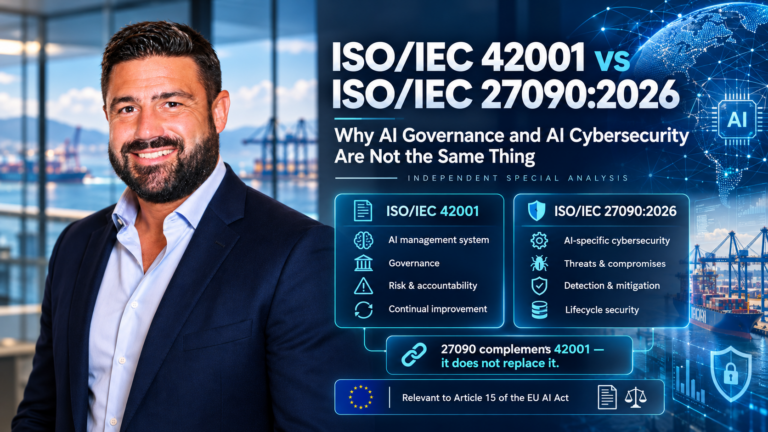
Does the new AI cybersecurity standard replace ISO/IEC 42001, complement it, or expose an important distinction that organizations need to understand?
By Alexandros Engelen | Cybersecurity Strategist specializing in Maritime Cyber Risk
A new standard, and an important question
On 14 October 2026, the ISO – International Organization for Standardization and the IEC (International Electrotechnical Commission) published ISO/IEC 27090:2026, Cybersecurity – Artificial intelligence (AI) – Addressing security threats and compromises to AI systems.
The publication arrives as organizations across virtually every industry are expanding their use of artificial intelligence. AI is becoming embedded in customer services, cybersecurity operations, engineering analysis, business decision-making and critical infrastructure.
But the growing adoption of AI has also introduced a governance and security challenge.
How can an organization demonstrate that its use of AI is both responsibly managed and adequately protected against AI-specific cybersecurity threats?
ISO/IEC 42001:2023 already provides an international framework for establishing an Artificial Intelligence Management System (AIMS). Why, then, is another international standard necessary?
The answer lies in understanding the differences between organizational AI governance, conventional information security and threats specific to AI systems.
ISO/IEC 27090 does not replace ISO/IEC 42001. The two standards address different, complementary aspects of AI risk management.
However, understanding how they work together is more important than simply recognizing that both exist.
1. ISO/IEC 42001: Establishing accountable AI governance
Published in December 2023, ISO/IEC 42001 is the first international management-system standard dedicated to artificial intelligence.
It specifies requirements and provides guidance for establishing, implementing, maintaining and continually improving an Artificial Intelligence Management System.
Its primary objective is to help organizations manage AI responsibly through an established organizational framework.
That includes addressing AI-related risks and opportunities, assigning responsibilities, establishing policies and objectives, managing the AI lifecycle, assessing impacts and reviewing the effectiveness of the management system.
ISO/IEC 42001 follows the management-system approach found in other established international standards, using the Plan–Do–Check–Act cycle.
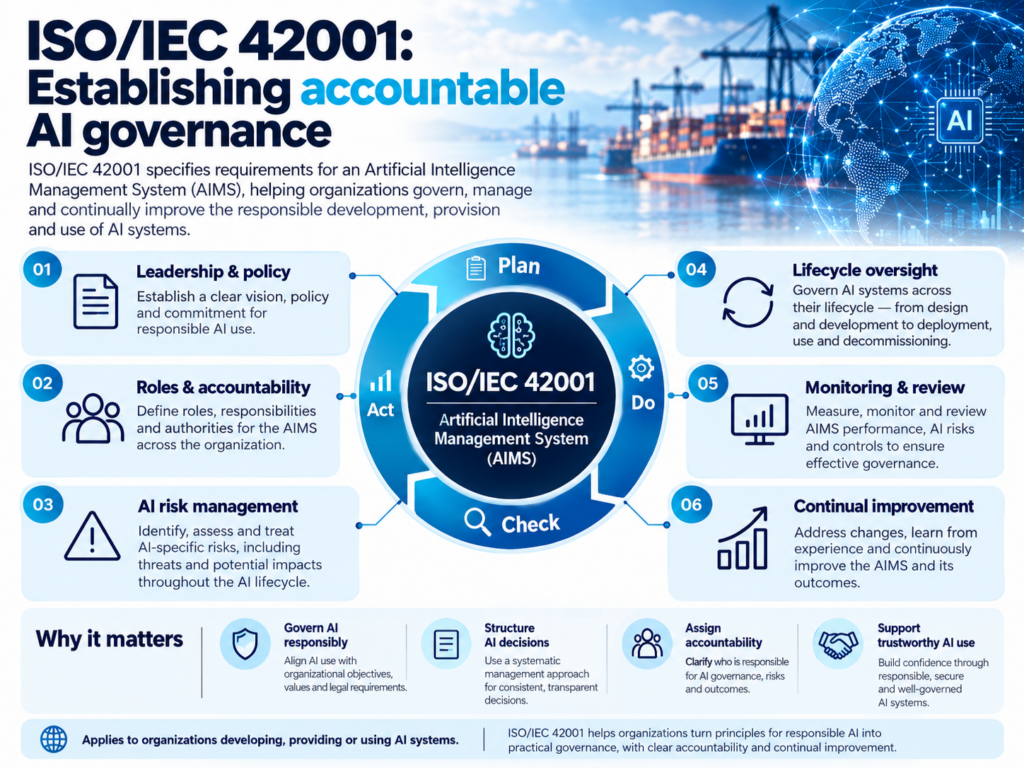
Its scope extends beyond cybersecurity.
It considers the wider organizational implications of developing, providing or using AI systems, including accountability, transparency, appropriate oversight and the potential effects of AI on affected parties.
Consider a company introducing an AI system to support important business decisions.
ISO/IEC 42001 provides a framework for asking:
- Why is the organization using this AI system, and for what approved purpose?
- Who is accountable for its deployment and operation?
- What risks and impacts have been identified?
- How are responsibilities shared with suppliers and other interested parties?
- What forms of oversight, monitoring and review are appropriate?
- How will the organization respond when the system changes or produces unexpected outcomes?
These are management and governance questions, although the answers can have significant cybersecurity implications.
Crucially, ISO/IEC 42001 already addresses risk, lifecycle management and the selection of appropriate controls. It should not be characterized as a standard concerned only with policy documents.
Its contribution is to establish an organizational system within which appropriate decisions, risk treatments and controls can be selected, implemented and evaluated.
ISO/IEC 42001 determines how an organization manages its AI responsibilities. It does not, by its existence alone, prove that every individual AI system is secure.
Source: ISO/IEC 42001:2023 – Official ISO publication
2. ISO/IEC 27090:2026: Understanding threats to AI systems
ISO/IEC 27090:2026 approaches the problem from a different perspective.
- Its purpose is to help organizations understand security threats and compromises affecting AI systems throughout their lifecycle, including their consequences and approaches to detection and mitigation.
- Its scope applies to organizations of different types and sizes that develop or use AI systems.
According to ISO’s official description, the new standard specifically addresses issues such as data poisoning and model theft while recognizing the continuing importance of established cybersecurity practices.
This distinction matters because AI systems introduce security considerations that cannot always be understood adequately through conventional infrastructure-focused assessments alone.
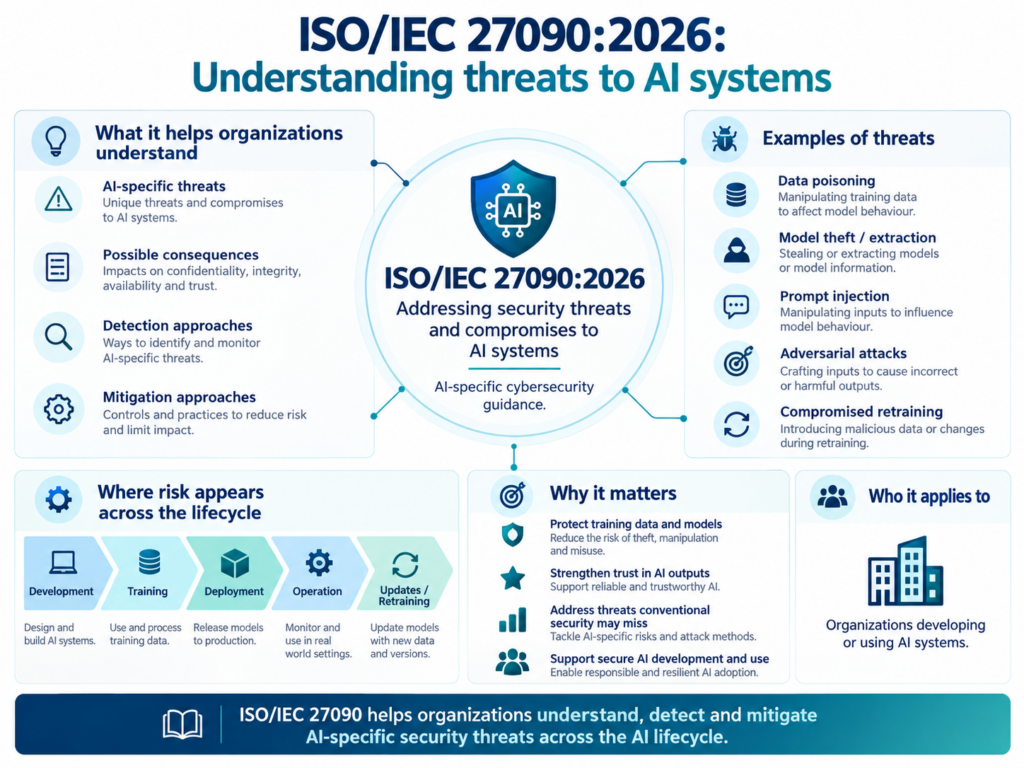
An organization may have strong identity management, endpoint security, network segmentation, logging and vulnerability-management practices, yet still face security threats involving the AI model, its data, its interactions or its updating process.
Consider the following examples:
Data poisoning
An attacker may attempt to manipulate data that a model uses during training or subsequent updates.
Depending on the model, the data pipeline and the attacker’s influence, this could change model behaviour, reduce reliability or introduce targeted errors.
The relevant security question is not simply whether the database is accessible to unauthorized users. It is whether the organization can establish sufficient trust in the origin, integrity and suitability of the information used to train or update the model.
Model theft or extraction
AI models may represent substantial intellectual property and commercial value.
Threats can involve unauthorized access to model artifacts or attempts to extract information through interactions with a deployed service.
Protection therefore involves considering both underlying access controls and the ways a model is exposed and used.
Adversarial manipulation
Some attacks are designed to influence how a model interprets inputs or produces outputs.
In machine-learning applications, adversarially manipulated inputs may affect classification or predictions. In generative AI applications, malicious instructions embedded in inputs or retrieved content may attempt to redirect model behaviour.
The mechanisms vary significantly across architectures and use cases. They should not be treated as one interchangeable category of attack.
Compromised retraining
One of the most consequential risks described in ISO’s public explanation concerns model updates.
Data collected during normal operation may eventually become part of a future training or retraining dataset.
If that information has been manipulated or corrupted, a compromise originating in operational data can influence later versions of the model.
This is especially relevant to organizations operating AI systems that evolve through periodic updates or continuous learning.
AI cybersecurity must consider not only where a model operates, but also what it learns from, what it trusts, how it is accessed and how it changes.
That is the specialized perspective ISO/IEC 27090 brings to the discussion.
Source: ISO/IEC 27090:2026 – Official ISO publication and IEC publication record.
3. The fundamental differences between the two standards
Although their subject matter overlaps, ISO/IEC 42001 and ISO/IEC 27090 are not equivalent documents.
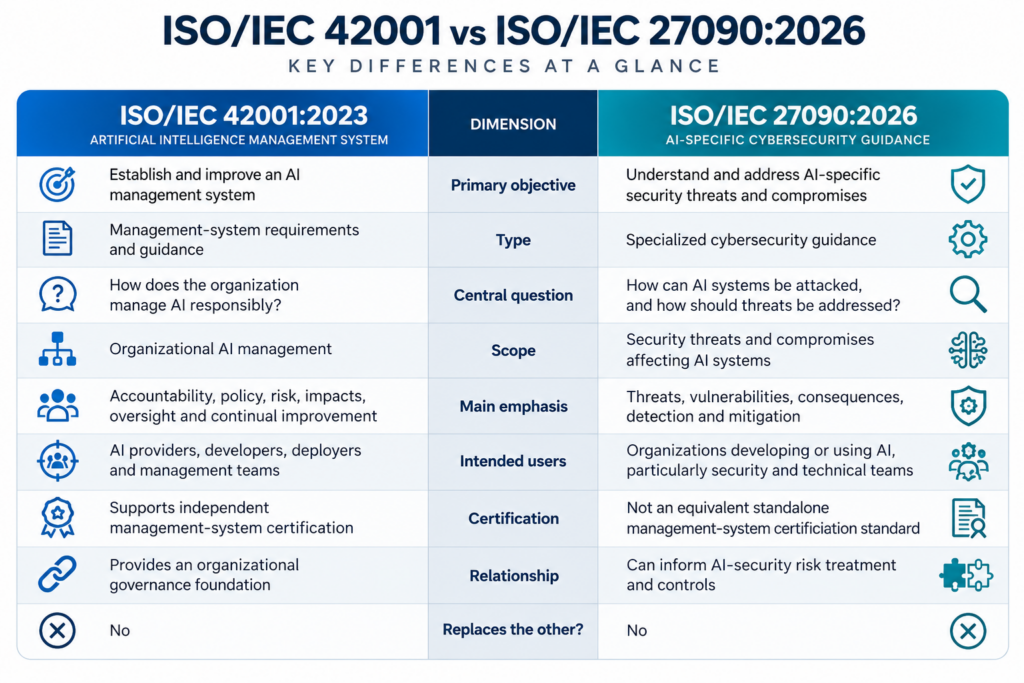
The distinction can be summarized through two questions.
- ISO/IEC 42001 asks: Does the organization have an effective system for governing and managing its use or provision of AI?
- ISO/IEC 27090 asks: What AI-specific cybersecurity threats and compromises need to be understood, and how can their consequences be detected and mitigated?
These questions are related, but they are not interchangeable. A well-governed AI programme can still contain technical weaknesses.
Likewise, an AI application protected by sophisticated security controls can still be deployed without adequate accountability, impact assessment or operational oversight.
Effective AI assurance requires both perspectives.
4. Does ISO/IEC 27090 replace or complement ISO/IEC 42001?
The answer is clear: ISO/IEC 27090 complements ISO/IEC 42001. It does not supersede, amend or replace it.
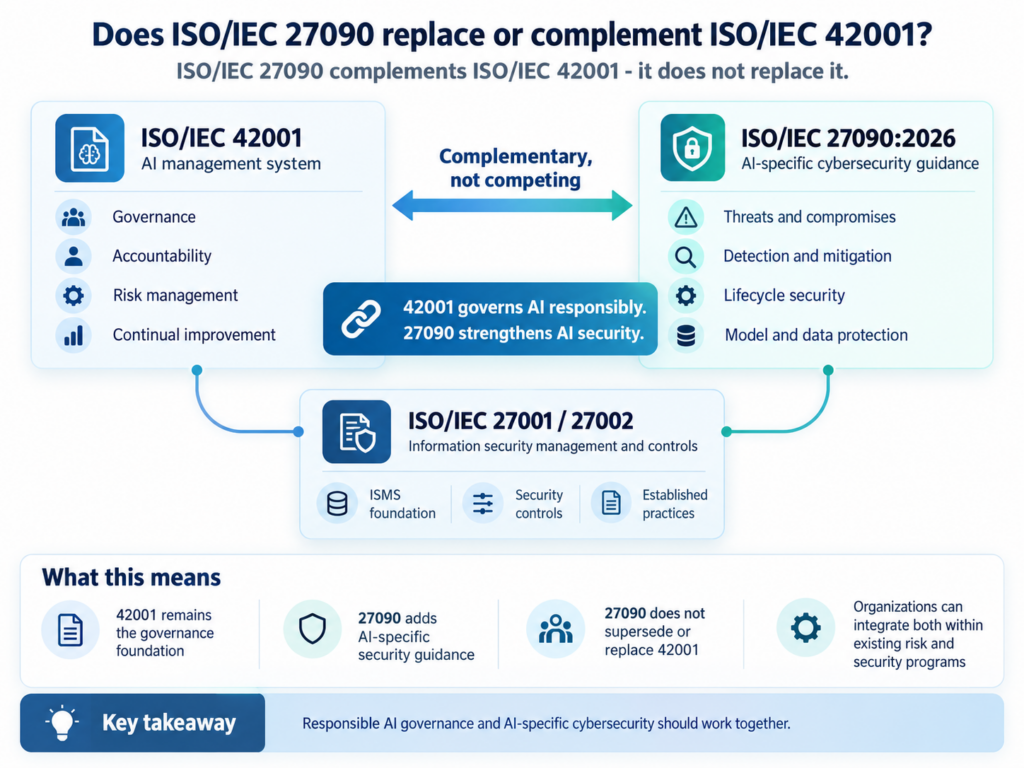
There is also an important third standard to consider: ISO/IEC 27001, which specifies requirements for an Information Security Management System (ISMS).
ISO explicitly explains that ISO/IEC 27090 complements the established security practices addressed by ISO/IEC 27001 and ISO/IEC 27002 by providing additional guidance on AI-specific threats.
This suggests a useful three-layer approach to organizational assurance:
ISO/IEC 42001 – AI governance
Establishes how the organization manages AI-related responsibilities, risks, controls and continual improvement.
ISO/IEC 27001 and ISO/IEC 27002 – Established information-security management and controls
Provide a framework for managing information-security risk and implementing appropriate security controls across relevant technology and information assets.
ISO/IEC 27090 – AI-specific cybersecurity guidance
Helps organizations examine threats and compromises involving AI models, training data, operational inputs and other AI-system components. These are complementary functions, not mutually exclusive alternatives.
An organization with an established ISMS and an AIMS may be able to incorporate AI-specific threat assessments and related safeguards into its existing governance, security and risk-management processes.
There is no inherent reason to establish an entirely separate management system simply because ISO/IEC 27090 has been published.
Equally, organizations do not need ISO/IEC 42001 certification before they can benefit from ISO/IEC 27090 guidance.
The practical objective is integration: one coherent approach to managing AI risks, with responsibilities assigned and technical safeguards selected according to the organization’s actual exposure.
5. A question for certified organizations: Is ISO/IEC 42001 enough?
This is where the distinction becomes particularly important for boards, CISOs and GRC professionals.
ISO/IEC 42001 supports independent management-system certification within an organization’s defined scope.
Certification can provide evidence that an organization’s AIMS has been assessed against the standard’s applicable requirements. However, certification should not be interpreted as a blanket security guarantee for every AI system developed or deployed by the organization.
An assessment of organizational management processes is not equivalent to comprehensive technical security testing of every application, model, integration and dataset.
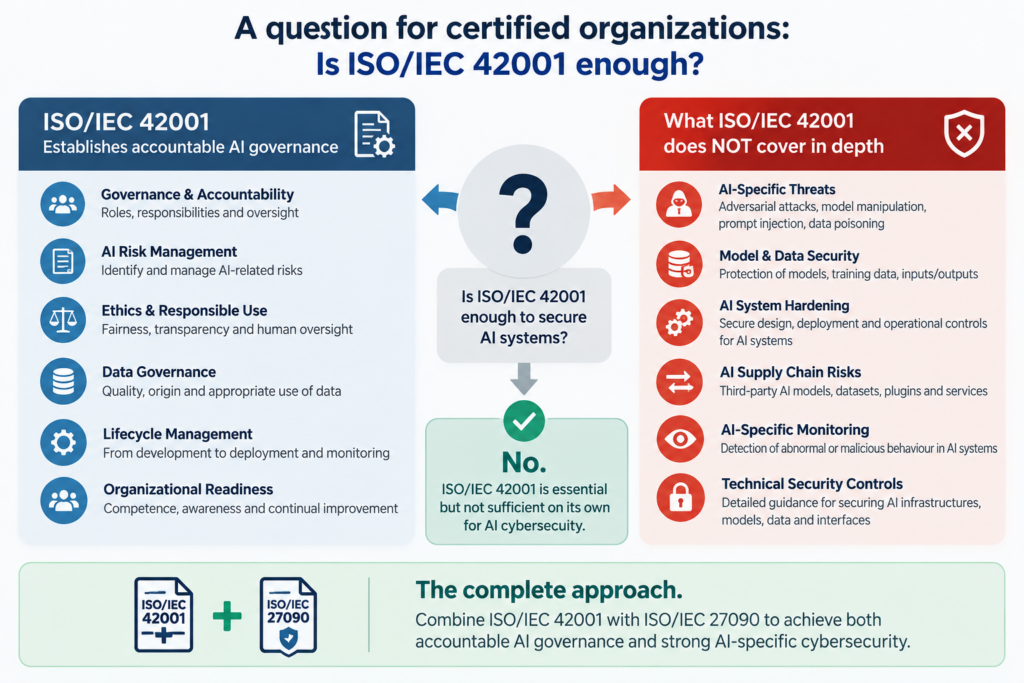
Consider an organization that has established its AI policy, documented relevant risk assessments, appointed responsible personnel and implemented appropriate oversight processes. These are important governance foundations.
But the organization must still consider whether its deployed AI services could be affected by manipulated datasets, exposed model interfaces, compromised dependencies or unauthorized model changes.
The two forms of assurance should reinforce each other.
ISO/IEC 27090 can help an organization make more informed security-risk decisions within its existing management arrangements.
This does not mean that every ISO/IEC 42001-certified organization necessarily has inadequate AI security. Nor does the publication of ISO/IEC 27090 invalidate existing certifications or automatically require a new certification audit. It means that security-risk assessments should remain current as relevant threats, technology and available guidance evolve.
The question should not be whether an organization holds an AI certificate. It should be whether its governance and security arrangements are effective against the risks of the AI systems it actually operates.
6. The EU AI Act: Where regulation enters the equation
The relationship between these standards becomes particularly relevant in the context of the EU AI Act.
Regulation (EU) 2024/1689 establishes a risk-based legal framework for artificial intelligence, with different obligations depending on the AI system, the relevant actor and the applicable provisions.
One of its key cybersecurity provisions is Article 15, which addresses accuracy, robustness and cybersecurity for high-risk AI systems. Article 15 requires high-risk AI systems to achieve appropriate levels of accuracy, robustness and cybersecurity throughout their lifecycle.
Its cybersecurity provisions specifically address resilience against attempts to alter the use, outputs or performance of AI systems by exploiting vulnerabilities.
They also contemplate measures addressing threats involving training data, pretrained components, adversarial inputs, confidentiality and model vulnerabilities.
The connection with ISO/IEC 27090 is therefore substantial.
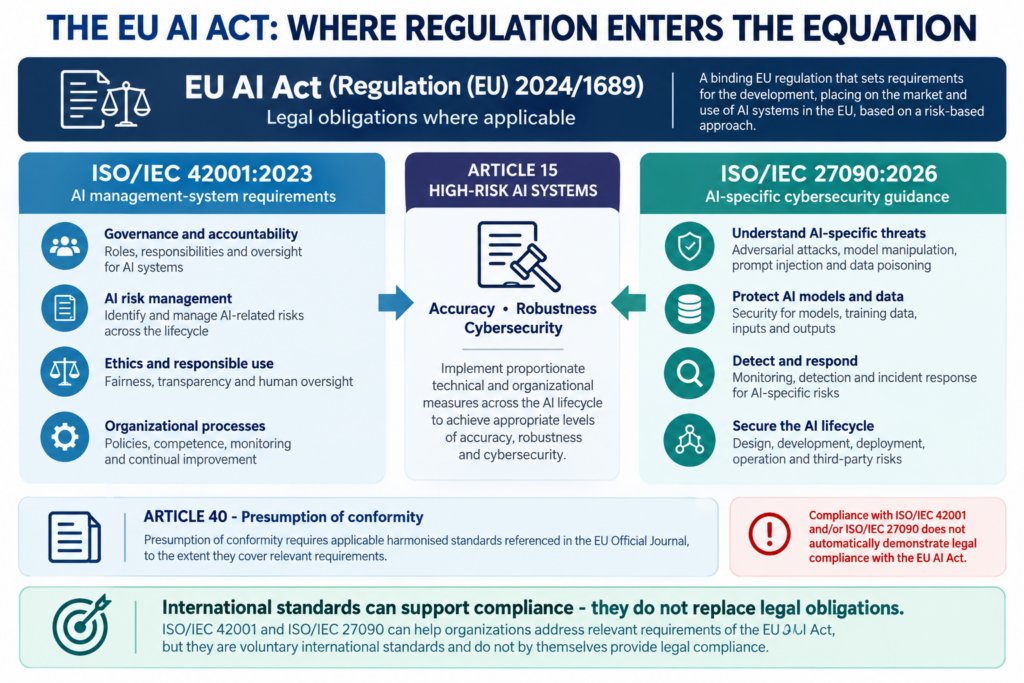
The standard’s focus on AI-specific cybersecurity threats can help organizations understand and select measures relevant to the security outcomes addressed by Article 15.
ISO/IEC 42001, meanwhile, can help establish the wider organizational processes through which relevant AI obligations, responsibilities, risk assessments and controls are governed.
However, an important legal boundary must be respected.
Neither implementing ISO/IEC 42001 nor applying ISO/IEC 27090 automatically establishes compliance with the EU AI Act.
Under Article 40, a presumption of conformity depends on applicable harmonised standards whose references have been published in the Official Journal of the European Union, and only to the extent they cover the relevant legal requirements.
An international standard does not acquire that status merely because ISO and IEC have published it. Furthermore, a presumption of conformity under a harmonised standard should not be confused with ISO management-system certification.
The EU AI Act also includes separate provisions concerning conformity assessment and, under defined conditions, cybersecurity certification or compliance with relevant Cyber Resilience Act requirements.
These mechanisms have different legal foundations and cannot be collapsed into a general claim that an organization is “AI Act certified.”
As of October 2026, the EU AI Act is already partially applicable, while the amended framework provides later application dates for certain high-risk AI provisions:
- 2 December 2027 for relevant Annex III high-risk systems
- 2 August 2028 for relevant Annex I product-related systems.
The applicable obligations must be assessed for each system and role. Simply operating AI in shipping, logistics or critical infrastructure does not automatically make every application a high-risk AI system under the Act.
For decision-makers, the distinction is straightforward:
The EU AI Act establishes applicable legal obligations. ISO/IEC 42001 supports AI governance. ISO/IEC 27090 provides AI-specific cybersecurity guidance.
Each has value, but none can substitute automatically for another.
Sources: EU AI Act – Article 15, Article 40, Article 42, and European Commission implementation overview.
7. The numbers: What AI management-system certification tells us
The growth of AI governance standards is also becoming visible in international certification data.
The ISO Survey 2025, reporting accredited management-system certifications as of 31 December 2025, provides an early international baseline for ISO/IEC 42001.
Published analyses of the dataset identify:
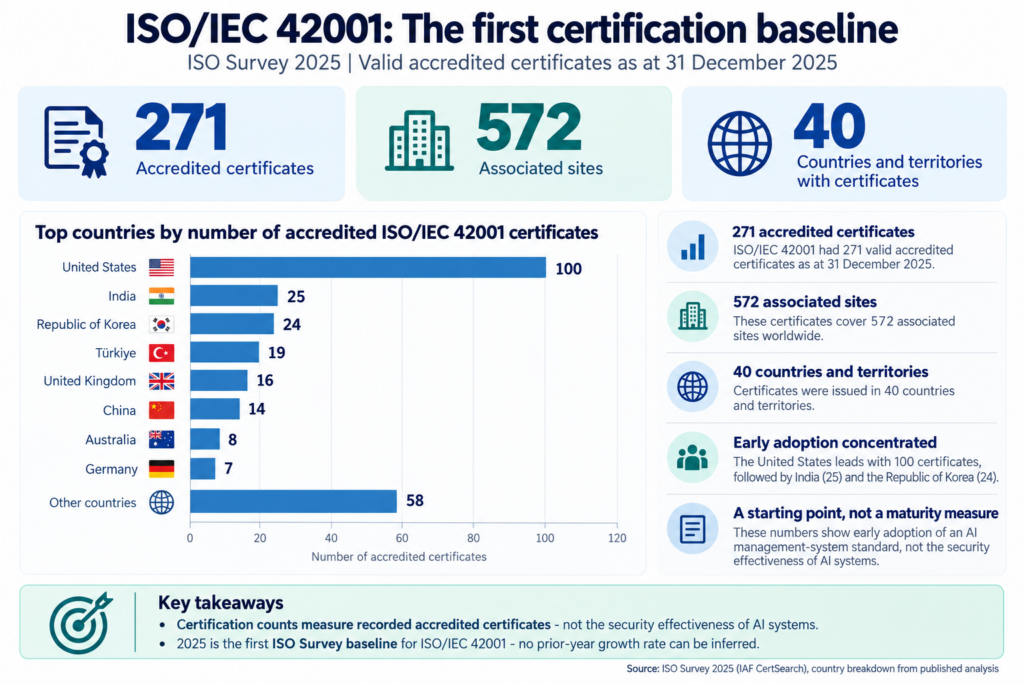
- 271 recorded accredited ISO/IEC 42001 certificates.
- 572 associated certified sites.
- 40 countries and territories with recorded certificates.
- 100 certificates in the United States, representing approximately 36.9% of the reported global total.
These figures require careful interpretation.
The ISO Survey counts certificates recorded within its defined accredited-certification dataset. It is not a count of all organizations using ISO/IEC 42001, all organizations with mature AI governance, or every AI application under management.
Coverage can vary by geography, certification body and reporting completeness.
The dataset also should not be used to calculate an unsupported growth rate from the preceding year, because ISO/IEC 42001 was newly included in the 2025 survey series.
Nevertheless, the figures provide a useful indication that formal AI management-system certification remains at an early stage compared with long-established management-system standards.
More importantly, the number of certificates tells us nothing directly about the effectiveness of AI-specific cybersecurity controls.
A certificate count cannot establish whether participating organizations have successfully defended their AI systems against model theft, data poisoning or other security compromises.
That is why governance metrics and technical assurance metrics must remain distinct.
Source: ISO Survey, with reported 2025 results cross-checked against published dataset analyses.
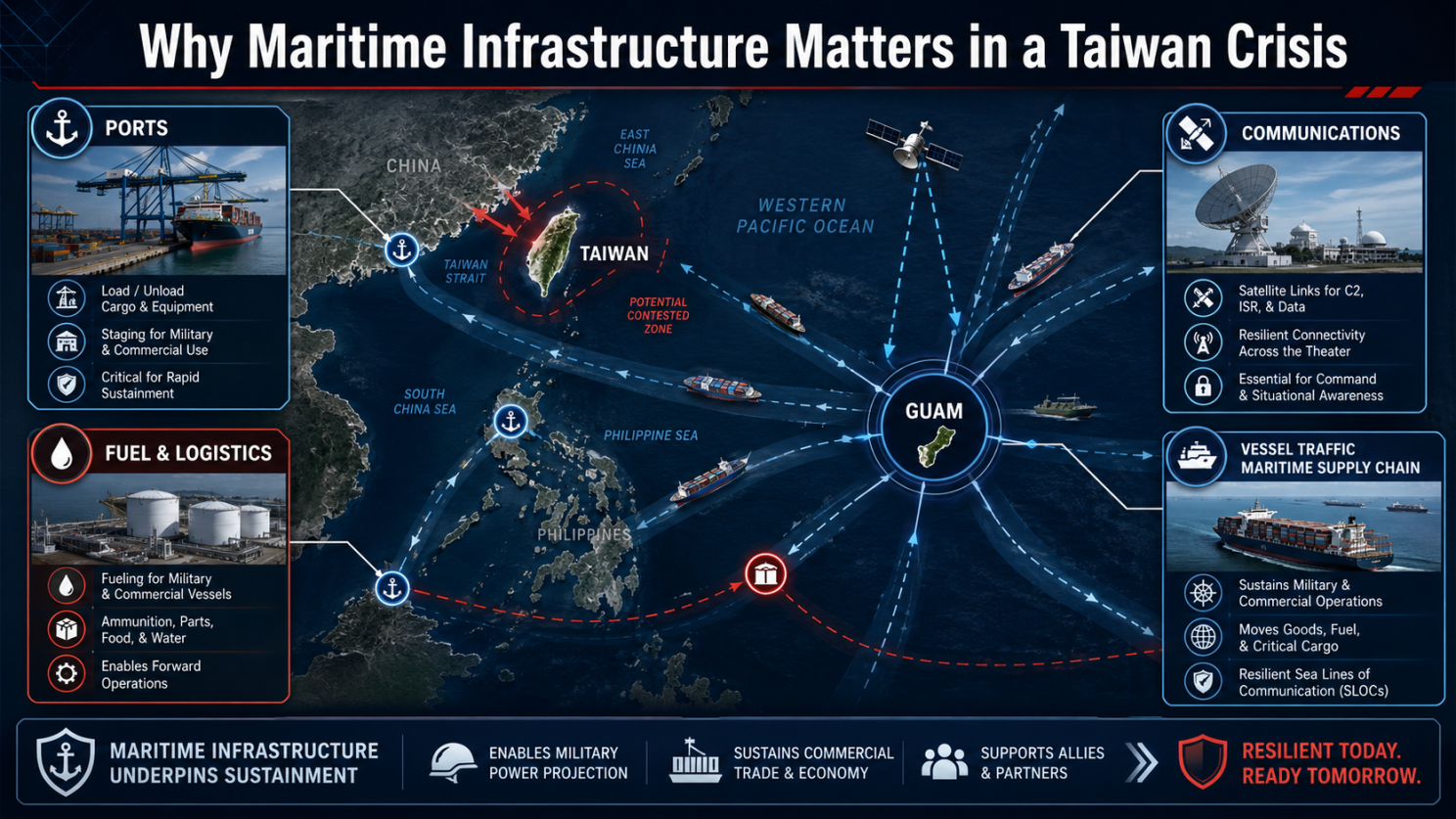
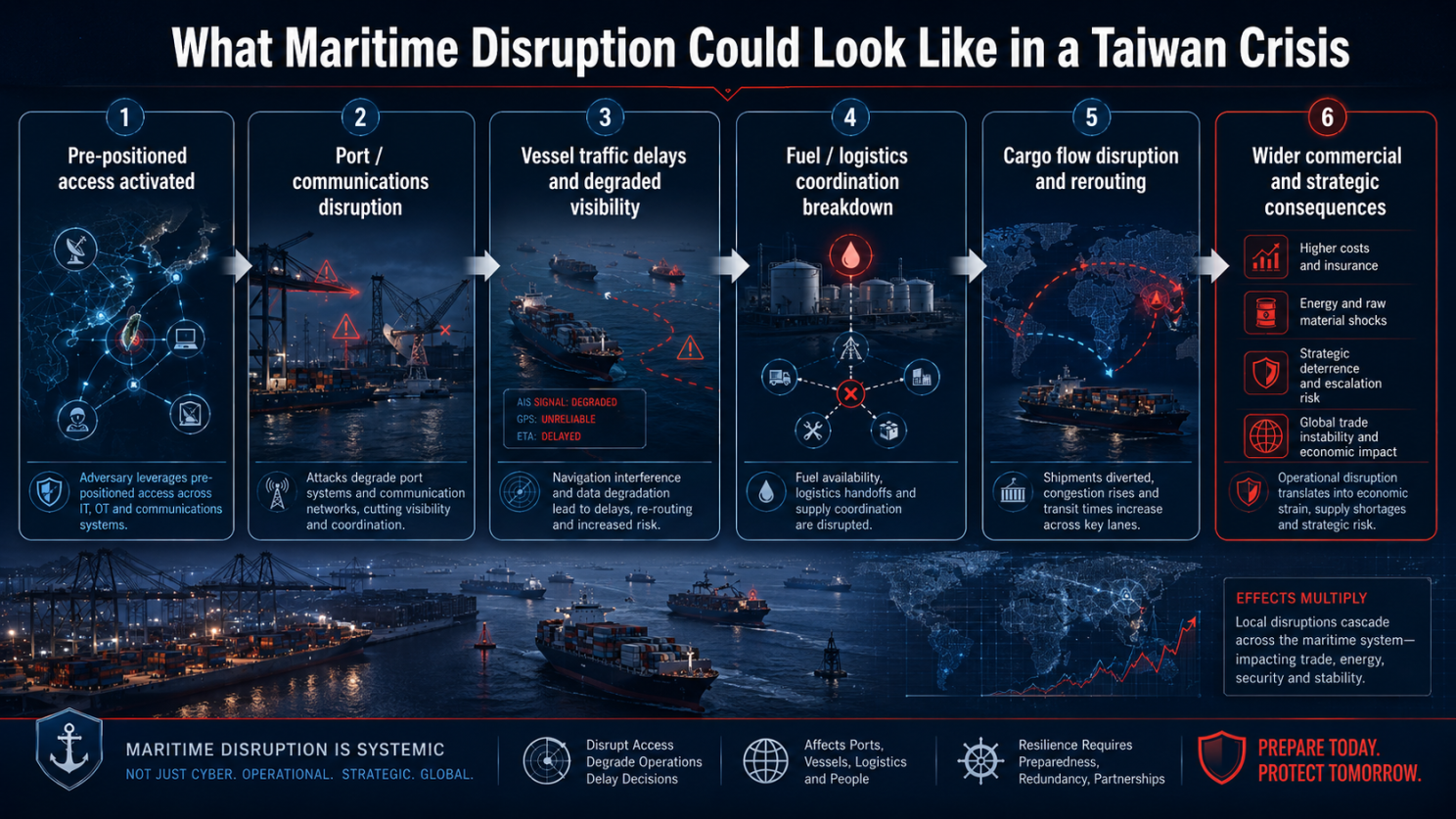
8. Why the distinction matters to maritime and critical infrastructure
The maritime industry illustrates why AI governance and AI cybersecurity cannot be treated as the same discipline.
Shipping companies, ship managers, port operators and maritime technology suppliers are exploring AI across business and operational activities.
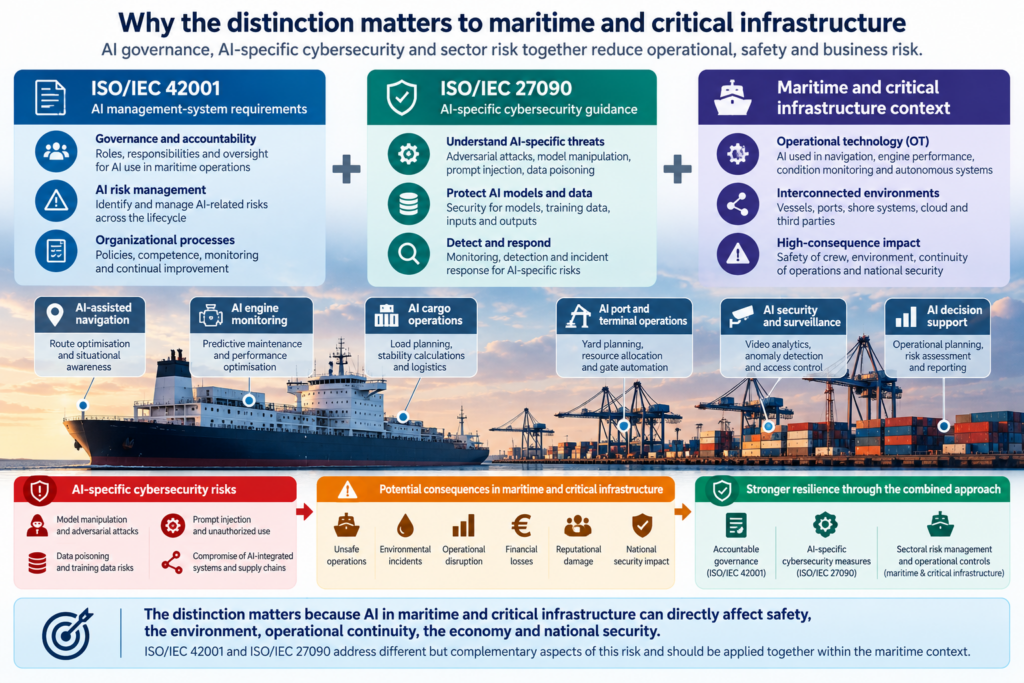
Applications may include maintenance analytics, route planning support, document processing, anomaly detection, logistics optimization and cybersecurity operations.
The risks associated with these applications differ significantly.
Consider a hypothetical ship management company using an AI-powered predictive maintenance application. The system receives historical and operational machinery data, identifies patterns and generates recommendations for engineering teams.
From an ISO/IEC 42001 perspective, the organization needs to determine why the AI system is being used, who is accountable, what its limitations are, how its outputs are reviewed and how risks are monitored.
From an ISO/IEC 27090 perspective, it also needs to consider whether training or operational data can be manipulated, whether the model or its interfaces can be compromised, and whether model updates introduce new security exposures.
Now consider a hypothetical attempt to manipulate maintenance data. If the manipulated information reaches the AI application, it might affect the resulting recommendation.
Whether this leads to an operational consequence depends on the system architecture, the quality of validation, engineering oversight, the decisions made and the safeguards in place.
It would be technically incorrect to assume that compromising an AI application automatically means compromising vessel operational technology or machinery control.
That distinction matters.
AI-related cyber risk can influence operational decisions without an attacker ever obtaining direct control of onboard OT.
Conversely, a properly designed workflow with effective data validation, independent engineering review and controlled decision authority can help reduce the likelihood of an AI-generated error becoming an unsafe action.
This is where AI governance, security engineering and maritime operational resilience intersect.
The same reasoning applies to shore-based AI applications supporting port and terminal operations. The nature of the risk depends on the actual system connections, data dependencies, decisions and operational safeguards.
The objective is not to label every maritime AI system as safety-critical.
It is to understand which AI-supported decisions matter, what could undermine them, and what measures are proportionate to the consequences.
9. What should CISOs, boards and AI governance leaders do now?
The publication of ISO/IEC 27090 should trigger a focused review of existing AI-security risk assessments, not an automatic decision to establish another compliance programme.
The starting point is visibility.
Organizations need to know which AI systems are in use, including externally provided services and AI functions embedded in existing products.
They should establish the intended purpose, accountable owner, data dependencies, relevant suppliers, potential operational consequences and applicable legal requirements for each significant use case.
From there, the work should become more specific.
- For boards and executive management, the priority is obtaining credible assurance that consequential AI risks are understood, assigned and managed. Reporting should distinguish organizational control maturity from technical security evidence.
- For CISOs and security teams, the priority is assessing AI-specific attack surfaces and determining whether existing information-security controls adequately address model, data, interface and lifecycle risks.
- For AI governance and GRC leaders, the priority is connecting the results of technical assessments to organizational risk ownership, treatment decisions, oversight processes and management review.
- For AI engineering and application owners, the priority is understanding how systems behave under adverse conditions, how updates are controlled, how model and data integrity are assessed, and how security issues are detected and addressed.
- For maritime technical and operational leaders, the priority is ensuring that AI-supported decisions have appropriate operational validation, human oversight and fallback arrangements, especially where errors could influence safety or continuity.
Rather than duplicating existing processes, organizations should connect AI-specific security findings to their established risk registers, change-management arrangements, incident-response procedures, supplier oversight and internal assurance activities.
The necessary evidence will depend on the AI application. It may include threat assessments, model and data provenance records, security-testing results, access-control reviews, monitoring records, change approvals and documented operational exercises.
What matters is whether the organization can demonstrate that selected measures are appropriate and effective for its actual risks.
10. The bigger lesson: Governance does not equal security, and security does not equal governance
The publication of ISO/IEC 27090:2026 reinforces an important principle.
AI risk cannot be managed adequately through documentation alone, nor can it be reduced to a collection of technical safeguards.
An organization can establish sophisticated policies, roles and risk processes while still overlooking important vulnerabilities in its AI applications.
Another organization may deploy strong technical security measures while lacking sufficient accountability over what AI systems are permitted to do, how their recommendations are used or how their wider impacts are assessed.
Both are weaknesses.
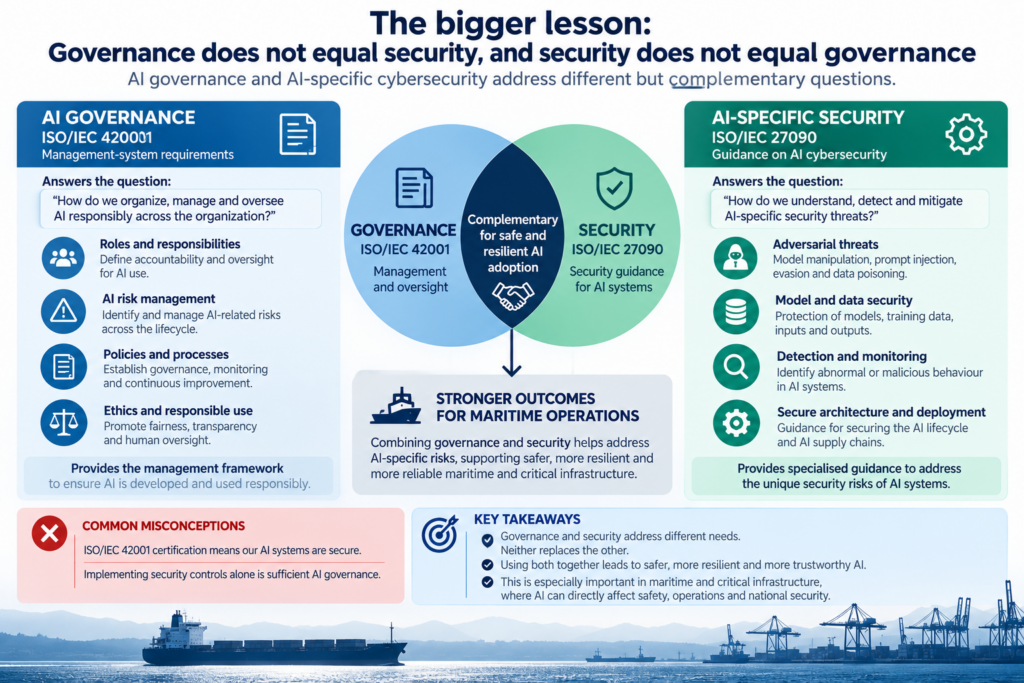
- ISO/IEC 42001 provides a management-system framework for governing AI.
- ISO/IEC 27090 contributes specialized understanding of AI-specific cybersecurity threats and their potential consequences.
- ISO/IEC 27001 and ISO/IEC 27002 remain relevant to established information-security management and controls.
Together, these references can support a more coherent approach to managing AI-related risks, provided organizations translate them into actual responsibilities, safeguards, testing and evidence.
The arrival of ISO/IEC 27090 does not mean that organizations should replace their AI governance frameworks. It means that their governance must be informed by an increasingly mature understanding of how AI systems can be attacked and compromised.
For executives, CISOs and operational decision-makers, that is the distinction worth remembering.
The objective is not simply to demonstrate that AI is governed. It is to demonstrate that AI is governed responsibly, protected proportionately and used within operationally acceptable limits.
About the author
Alexandros Engelen is an independent cybersecurity strategist specialising in maritime cyber risk. His work examines the relationship between cybersecurity threats, technology governance, operational resilience, regulation and the real-world consequences of digital dependencies across the maritime industry.
References
- ISO – ISO/IEC 42001:2023: Artificial intelligence management systems.
- ISO – ISO/IEC 27090:2026: Addressing security threats and compromises to AI systems.
- IEC – ISO/IEC 27090:2026 official publication record.
- ISO – ISO/IEC 27001:2022.
- ISO – The ISO Survey.
- European Union – Regulation (EU) 2024/1689, EU AI Act.
- European Commission – Article 15: Accuracy, robustness and cybersecurity.
- European Commission – Article 40: Harmonised standards.
- European Commission – Article 42: Presumption of conformity with certain requirements.
- European Commission – AI Act implementation and timeline.
#ISO42001 #ISO27090 #AIGovernance #AICybersecurity #EUAIAct #GRC #CyberRiskManagement #MaritimeCyberSecurity #Governance
Editorial methodology:
- This analysis uses official publication descriptions and publicly accessible regulatory material, supplemented by certification-data reporting.
- It does not reproduce the full licensed texts of the standards or purport to provide an exhaustive clause-by-clause mapping.
- Maritime examples are hypothetical and do not describe disclosed incidents.
- Regulatory discussion is informational and is not a determination of legal compliance for any particular organization.